
Safety Statement |
||||||||||||||||||||||||||||||||||||||||||||||||||||||||||||||||||||||||||||||||
SAFETY STATEMENT
|
||||||||||||||||||||||||||||||||||||||||||||||||||||||||||||||||||||||||||||||||
Draft Version 1.0 |
Changes Made: |
Accepted by: |
Prepared by: Olive Safety
NSC Campus,
Mahon,
Cork.
Tel: 021 2307108
E-mail: info@olivesafety.ie
www.olivesafety.ie
TABLE OF CONTENTS
1 SAFETY POLICY Click
2 SAFETY MANAGEMENT STRUCTURE Click
3 RESPONSIBILITIES Click
3.1 Board of Management
3.2 Tommy Maher
3.3 Staff
3.4 The Safety Representative – on Appointment
3.5 Visitors & Contractors
4 DOCUMENTATION AND DISTRIBUTION OF THE SAFETY STATEMENT Click
5 PROVISION OF SAFETY TRAINING AND INSTRUCTION Click
6 ARRANGEMENTS FOR CARRYING OUT THE POLICY Click
7 PROVISION OF PRACTICAL AND SAFE WORKING SYSTEMS Click
7.1 Safe Access and Egress
7.2 Fire Safety
7.3 Welfare Facilities
7.4 Alcohol & Drugs
7.5 Manual HAndling
7.6 Electrical Safety
7.7 The Role of the Safety Officer
8 PROVISION OF PERSONAL PROTECTIVE EQUIPMENT Click
8.1 PPE Training
9 CONSULTATION Click
10 INTIMIDATION AND HARASSMENT Click
Complaints Procedure
Grievance Procedure
11 SEXUAL HARASSMENT Click
Complaints Procedure
12 GRIEVANCE PROCEDURE Click
Investigation
Disciplinary Hearing
Appeal
Disciplinary Action
Oral Caution
First Written Warning
Final Written Warning
Dismisssal
Summary Dismissal
13 PREGNANT STAFF Click
14 STRESS POLICY Click
15 SMOKING POLICY Click
16 FIRST AID Click
17 EMERGENCY / FIRE PROCEDURES Click
17.1 Fire Prevention Policy
17.2 Emergency Plan
18 ACCIDENT/INCIDENT REPORTING Click
19 BOARD OF MANAGEMENT ANNUAL REVIEW Click
20 MEMBERS OF PUBLIC, CONTRACTORS AND VISITORS Click
20.1 Visitors
20.2 Sub-contractors
21 RISK ASSESSMENTS Click
21.1 Risk Assessment Process
21.2 Hierarchy of Controls
21.3 Summary
22 CONCLUSION Click
23 LIST OF APPENDICES Click
APPENDIX 1 – INSPECTION AND TESTING OF FIRE PREVENTION EQUIPMENT Click
Recommended Contents of First Aid Boxes
APPENDIX 2 – VDU USER CHECKLIST & VDU WORKSTATION SETUP DIAGRAMS Click
APPENDIX 3 – INSPECTION AND TESTING SCHEDULE FOR ELECTRICAL EQUIPMENT Click
APPENDIX 4 – ACCIDENT / INCIDENT REPORT FORM Click
APPENDIX 5 – RISK ASSESSMENTS Click
APPENDIX 6 - STAFF DECLARATION Click
Top of Page
THE SAFETY STATEMENT
The Safety, Health and Welfare at Work Act, 2005 requires Scoil Naomh Fiachra, Clontubrid, Freshford, Co. Kilkenny to prepare and have available for its officers a safety statement setting out its policy on safety. In accordance with Section 20 – Hazard Identification and Risk Assessment, of the Safety, Health and Welfare Act, 2005, Scoil Naomh Fiachra has prepared this Safety Statement.
This statement together with the following will be known collectively as the ‘safety statement’:
- Hazard identification and risk reduction guidelines,
- Allocation of responsibilities,
- Consultation procedure.
The Board of Management of Scoil Naomh Fiachra recognises the paramount importance of safety, health and welfare, to all its officers, in the successful conduct of its business. This Safety Statement, in accordance with the Safety, Health and Welfare at Work Act, 2005, outlines the policy of Scoil Naomh Fiachra in ensuring so far as is reasonably practicable, the Safety, Health and Welfare of its pupils, teachers, members of the public, contractors and visitors. The Safety Statement sets out an action programme for safeguarding the Safety, Health and Welfare of Scoil Naomh Fiachra pupils and teachers whilst at school and at work.
Scoil Naomh Fiachra is committed to complying with the requirements of the Safety, Health and Welfare at Work Act, 2005 and all other statutory requirements, Codes of Practice and National Standards.
It is important that you read this carefully and understand your role in the overall arrangements for Health and Safety at Scoil Naomh Fiachra.
Circulation
Name |
Title |
Safety Statement Revision:
The Headmaster is responsible for the issue, amendment and control of the Safety Statement. The Safety Statement will be reviewed on an annual basis by the Board of Management and will be changed accordingly as names of responsible persons change, or as risks change or changes in legislation occur.
A statement of fact for inclusion in the end of the year’s Annual Report as per the requirements of the Safety, Health and Welfare at Work Act, 2005 will also be prepared on an Annual basis.
1 Safety Policy
The Safety, Health and Welfare at Work Act, 2005 requires Scoil Naomh Fiachra to prepare and issue a safety statement setting out its policy on safety. This statement together with the following will be known collectively as the ‘safety statement’.
Scoil Naomh Fiachra is an educational institution providing education to both boys and girls. The Board of Management of Scoil Naomh Fiachra recognises the fundamental importance of safety, health and welfare, to all its officers, in the successful conduct of business. This Safety Statement, in accordance with the Safety, Health and Welfare at Work Act, 2005, outlines the policy of Scoil Naomh Fiachra for ensuring so far as is reasonably practicable, the safety, health and welfare of its pupils, teachers, members of the public, contractors and visitors. Scoil Naomh Fiachra will comply with the requirements of the Safety, Health and Welfare at work Act, 2005 and all other statutory requirements, Codes of Practice and National Standards.
Scoil Naomh Fiachra will ensure so far, as is reasonably practicable:
- Safe and healthy working conditions,
- Safe equipment and systems of work,
- Provision of appropriate information, instruction, training and supervision,
- Provision, where necessary, of a competent person to advise and assist in securing the health, safety and welfare of officers and others.
The detailed arrangements for achieving these objectives are set out in the main body of the Safety Statement.
The Board of Management has overall responsibility for health and safety within Scoil Naomh Fiachra Teachers share a responsibility with the Board of Management in ensuring their own safety while at work. Persons other than Staff (e.g. visitors, members of the public and contractors) also share in this responsibility.
Sufficient authority and resources, both financial and otherwise, will be made available to enable officers to carry out their responsibilities in a reasonable and efficient manner.
All staff will be made aware of and have access to this Safety Statement and arrangements for consultation on health and safety matters will be an integral part of the school’s safety policy.
This Safety Statement will be subject to revision and is liable to amendment, if circumstances change. While the Safety Statement is management’s program, in writing, for safeguarding safety and health in the workplace, it is also a proactive document and is part of a wider continual improvement and learning process in the area of safety, health and welfare at work.
Signed: _______________________________ Date: _______________________
Name: _______________________________
Title: Chairperson of Board of Management
2 Safety Management Structure
The persons or titles listed below, within the company safety management structure are responsible directly or by formal delegation for:
• The effective implementation of the safety policy ensuring that their areas of responsibility are run in accordance with the policy.
• Ensuring that all officers are trained to manage the implementation and ongoing monitoring of this safety policy.
Safety Management Structure in Scoil Naomh Fiachra
Board of Management › |
Principal › |
Staff › |
3 Responsibilities
Activities and Responsibilities for Health & Safety under the Safety, Health and Welfare at Work Act, 2005.
3.1 Board of Management
The Board of Management have ultimate accountability for the activities of the school. Safety begins at Board of Management level and the overall responsibility for the establishment and maintenance of an effective policy for Safety, Health and Welfare at Work rests with the Board of Management.
The Board of Management has overall responsibility for health and safety. The day to day responsibility is delegated to Tommy Maher who is the Headmaster. Acceptable health and safety practice will be achieved through the effective operation of a safety management system, safe systems of work, procedures and full officer’s co-operation.
The Board of Management shall:
- Demonstrate a commitment to safety, health and welfare by taking active steps to be aware of the safety record of the business and shall issue any necessary reasonable directives in the interest of the safety, health and welfare of all officers and third parties.
- The Board of Management will endeavour to ensure that there are sufficient funds and facilities available to enable the safety policy and objectives as outlined in this safety statement to be reasonably implemented.
- On an annual basis, appraise the effectiveness of the safety statement and the safety management system operated by Scoil Naomh Fiachra.
- Ensure that the responsibility for safety, health and welfare is properly assigned, understood and accepted at all levels.
- Procure advice and assistance from consultants whenever necessary and take heed, together with remedial action, on any matters brought to his/her attention in relation to safety, health and welfare.
3.2 School Principal
- Ensuring that competent staff and appropriate materials are available at all times to meet the requirements of the safety legislation applicable to the Authority.
- Ensuring that staff under his control and others, including contractors/ visitors, are made aware of and comply with the school’s health and safety statement and the organisation and arrangements for carrying it out.
- Ensuring that this safety statement is available to all staff and appropriate third parties.
- Ensuring that all staff under his control are held accountable for their performance in relation to safety, health and welfare and that this performance is evaluated at the time of their annual review.
- To organise his workplace so that operations or work are carried out to a satisfactory safety standard, so as to reduce the risk to persons, equipment and materials so far as is reasonably practical.
- To issue standard operating procedures in writing, where complex operational procedures are involved.
- Have an understanding of Irish health and safety legislation relevant to the school’s activities.
- Ensure that all operational hazards within the school are addressed; the risks understood and corrective measures are implemented to prevent danger to pupils and staff as far as is reasonably practical.
- Take prompt corrective action where unsafe conditions and/or unsafe acts are noted, or identified through accident/incident investigations.
- Ensure that all relevant health, safety and welfare information regarding new methods of accident prevention, new legislative requirements and codes of practice are acted upon in so far as is reasonably practical.
- Discipline any member of staff failing to comply with the safety policy.
- Investigate fully all reported accidents within 72 hours and advise on remedial measures to prevent a re-occurrence, and ensure all injured personnel are promptly referred to a Doctor or hospital for treatment if required.
- Ensure Safety Standards including the formulation of good housekeeping, maintenance and safety programmes are established.
- Ensure that Risk Assessments are conducted and reviewed for all activities.
- Ensure that all statutory examinations and inspections of equipment are carried out and records maintained.
- Ensure that all safety rules, regulations and procedures are kept under review so that they remain applicable to Scoil Naomh Fiachra.
- Ensure that all staff are familiar with emergency procedures, and that appropriate emergency facilities are available.
- Ensure that the school complies with all relevant Health and Safety legislation and that staff are aware of same.
- Ensure that procedures are put in place for consultation with staff in relation to the Safety, Health and Welfare at Work Act, 2005 and the Safety, Health and Welfare Act Work, (General Application) Regulations 2007 and the Safety, Health and Welfare at Work (Construction) 2006.
- Ensuring that thorough and prompt investigations are carried out into all reported accidents and that a completed Accident Report Form is submitted to the appropriate authority, e.g. HSA.
- Ensure that Scoil Naomh Fiachra through the implementation of the above strives for a philosophy of continuous improvement.
Activities and Responsibilities for Health & Safety under the Safety, Health and Welfare at Work Act, 2005.
3.3 Staff
Staff have general statutory obligations under the Safety, Health and Welfare at Work Act, 2005, Chapter 2 Section 13, which includes the following:
Officers must:
- comply with the relevant statutory provisions, as appropriate, and take reasonable care to protect his or her safety, health and welfare and the safety, health and welfare of any other person who may be affected by the officers’ acts or omissions at work,
- ensure that he or she is not under the influence of an intoxicant to the extent that he or she is in such a state as to endanger his or her own safety, health or welfare at work or that of any other person,
- if reasonably required by his or her employer, submit to any appropriate, reasonable and proportionate tests for intoxicants by, or under the supervision of, a registered medical practitioner who is a competent person, as may be prescribed,
- co-operate with his or her employer or any other person so far as is necessary to enable his or her employer or the other person to comply with the relevant statutory provisions, as appropriate,
- not engage in improper conduct or other behaviour that is likely to endanger his or her own safety, health and welfare at work or that of any other person,
- attend such training and, as appropriate, undergo such assessment as may reasonably be required by his or her employer or as may be prescribed relating to safety, health and welfare at work or relating to the work carried out by the officers,
- having regard to his or her training and the instructions given by his or her employer, make correct use of any article or substance provided for use by the officers at work or for the protection of his or her safety, health and welfare at work, including protective clothing or equipment,
- report to his or her employer or to any other appropriate person, as soon as practicable:
- any work being carried on, or likely to be carried on, in a manner which may endanger the safety, health or welfare at work of the officers or that of any other person,
- any defect in the place of work, the systems of work, any article or substance which might endanger the safety, health or welfare at work of the officers or that of any other person, or
- any contravention of the relevant statutory provisions which may endanger the safety, health and welfare at work of the officers or that of any other person, of which he or she is aware.
A person shall not intentionally, recklessly or without reasonable cause—
- misuse, damage or interfere with anything provided under the relevant statutory provisions or otherwise for securing the safety, health and welfare of persons at work, or
- place at risk the safety, health or welfare of persons in connection with work activities.
In addition, staff are reminded:
- Only carry out duties you are trained to perform.
- Keep work areas clean and uncluttered.
- Be careful when moving items.
- Do not run.
- Any form of dangerous pranks or unauthorised hazardous activities is totally prohibited on school premises.
Activities and Responsibilities for Health & Safety under the Safety, Health and Welfare at Work Act, 2005.
3.4 The Safety Representative – On Appointment
Part 4, Section 25(1) of the Safety, Health and Welfare at Work Act, 2005 states that staff may select a Safety Representative who has the following rights under the legislation:
- The Safety Representative can make representations on any aspects of safety, health and welfare at the place of work.
- The Safety Representative has the right to investigate accidents and dangerous occurrences in conjunction with the person responsible for health and safety. They shall not interfere with or obstruct the performance of any statutory obligation required to be performed by any persons under any of the relevant statutory provisions.
- In relation to the Health & Safety Authority;
- Make oral or written representations to HSA inspectors on matters of safety, health and welfare at work.
- To receive advice and information from HSA inspectors on matters of safety, health and welfare at work
- To accompany a HSA inspector on any tour of inspection other than a tour of inspection made by a HSA inspector for the purpose of investigating an accident.
- The Safety Representative subject to prior notice to the employer may carry out workplace health and safety inspections to determine any potential hazards on the premises.
- The Safety Representative subject to prior notice to the employer may investigate potential hazards and complaints made by any staff whom he represents relating to that staff members safety, health and welfare at the place of work.
Staff shall be advised of their right to appoint / select a safety representative, refer to Section 8 of this Safety Statement for further details on the workings of the Safety Committee.
Activities and Responsibilities for Health & Safety under the Safety, Health and Welfare at Work Act, 2005.
3.5 Visitors & Contractors
It is the responsibility of all school staff to ensure the safety of their visitors on the premises. All visitors (not including Contractors) to Scoil Naomh Fiachra including persons from the general public, sales people, consultants, inspectors, etc, are bound by the following rules:
- They should observe the Safety Rules and any instructions given by Scoil Naomh Fiachra personnel who enforce the school’s Safety Policy.
- They should not visit or commence work on site until the relevant safety rules and information has been read understood and accepted.
- They should not work on the premises unless covered by their insurance against risk.
- They should not enter unauthorised areas where they are not authorised to visit.
4 Documentation and Distribution of the Safety Statement
A copy of the Safety Statement will be issued to all relevant staff. The terms of the Safety Statement will be brought in an appropriate manner to the attention of all staff.
The Chairperson of the Board of Management shall hold the master copy of the Safety Statement.
The School Principal is responsible for the issue of new and revised Safety Statements. To ensure that each copy of the Safety Statement contains a record of all changes, the person responsible for Health & Safety will record changes or amendments on an amendment list, which will then be circulated to all on a circulation list.
Once signed off, this document is a public document and will be made available upon request to the Principal.
5 Provision of Safety Training and Instruction
Scoil Naomh Fiachra is committed to providing appropriate health and safety training for all staff, which will be sufficient to meet the school’s obligations under the Safety, Health and Welfare at Work Act, 2005 and other relevant legislation. The primary responsibilities for this rests with the Board of Management in co-operation with specialists as appropriate and the Board expects that all staff will co-operate in any training provided.
All staff employed by Scoil Naomh Fiachra will receive induction training to ensure that they fully understand the hazards of the equipment and what safety precautions and emergency procedures are required. The training shall involve an introduction to the company’s Safety Statement.
The Safety Representative, if/when appointed, will receive the necessary training as recommended by the HSA to carry out his/her role effectively. Training will be given, as necessary, to Management to ensure that they have the necessary skills and knowledge to organise the work safely without risk to health.
Training records will be maintained and will contain the following information:
- Date of training instruction or exercise,
- Duration of the training course,
- Name of Instructor delivering the training,
- Name of person’s undertaking the training,
- Nature and content of the training course.
Additional training courses will be provided to meet specific needs as they arise from time to time. Such courses may be carried out in-house or at an appropriate outside agency. All officers are required to co-operate with the company in the implementation of its training programme.
6 Arrangements for Carrying Out the Policy
The implementation of a safety, health and welfare policy is a function of the Board of Management and staff at all levels.
All staff members of the school must familiarise themselves with and ensure that their subordinates (if any) comply with all relevant safety, health and welfare regulations and instructions, and furthermore, must ensure that their subordinates are made aware of all information pertaining to safety.
If they wish to delegate any part of these duties to a colleague with special responsibility for safety, they may do so but the ultimate responsibility for safety still lies with them.
The Board of Management will consult with staff on safety to establish arrangements for securing co-operation in the work place on Safety, Health and Welfare.
The school’s safety, health and welfare officer has, in extreme circumstances, authority to order work to stop if he considers that continuation would seriously endanger health and/or safety.
The school will provide adequate and appropriate safety training to all staff members and will consider all reasonable requests made for training to be provided. Safety training will be included as a consideration at planning stages for new work practices, new machinery/plant, and new materials.
Safety information events will be held at regular intervals.
Annual safety checks and periodic audits will be carried out and the results audited.
A description of the specific duties of each of the key personnel responsible for standards in safety, health and welfare are detailed in this document. In some circumstances the positions mentioned may merge and in these cases the duties of one or more positions will be the responsibility of one person.
7 Provision of Practical and Safe Working Systems
It is the policy of Scoil Naomh Fiachra to ensure that tasks are within the competence and capacity of each staff member and the systems of work will be designed with that purpose in mind. They will include consideration for the safety and health of visitors/contractors.
7.1 Safe Access and Egress
In order to ensure that Scoil Naomh Fiachra pupils and staff have a safe access and egress to and from the school at all times, the following controls will be maintained while working on sites and company premises:
- Scoil Naomh Fiachra materials and equipment storage will not obstruct any fire or safety appliance, fire fighting equipment or emergency exits on the company premises where work is being conducted.
The following will be maintained where applicable:
- Good housekeeping standards will be maintained at all times and equipment will be stored away safely.
- Access routes and aisle ways will be kept clear of all stored materials at all times.
- Cables and other trip hazards will not be run across work areas and spills will be cleaned up immediately.
- Adequate lighting will be provided during the winter months where staff are working to allow for safe access and egress if required.
7.2 Fire Safety
Fire extinguishers are provided and correctly sited to meet safety requirements where required. These appliances are provided to deal with incipient fires. Trained personnel using these appliances should only tackle small fires.
All of Scoil Naomh Fiachra fire-fighting equipment is tested and serviced annually by certified contractors. In accordance with the recommendation of the appropriate Irish Standard I.S 291.1998 for fire equipment, 30% of extinguishers will be discharged each year and relevant staff will be trained in the safe and efficient use of the equipment.
- Scoil Naomh Fiachra staff are very aware of the potential of fire hazards as a result their activities or smoking on site. All our staff will take all reasonable care in their work activities to ensure we do not generate any potential fire hazards.
- Combustible materials will not be allowed to build up on the premises and will be removed to bins or skip on a regular basis.
- Any oily rags or waste, which is highly flammable, will be kept in metal containers and removed for appropriate disposal.
- Smoking will only be carried out in approved areas.
- Where hot work is carried out, with regards to maintenance and or construction/alteration of premises, appropriate fire fighting equipment will be maintained on site and in the vicinity of the hot works at all times.
- All fire fighting equipment located on the premises of Scoil Naomh Fiachra will be in accordance with the requirements of the area that it is being located, as well as meet the required classification for that area based on the classifications as per I.S. 290: 1986 standard.
 |
Class A: Wood, paper, cloth, trash, plastics—solids that are not metals. |
 |
Class B: Flammable liquids—gasoline, oil, grease, acetone. Includes flammable gases. |
 |
Class C: Electrical—energized electrical equipment. As long as it’s “plugged in.” |
 |
Class D: Metals—potassium, sodium, aluminum, magnesium. Requires Metal-X, foam, and other special extinguishing agents. |
- Any flammable liquids used on site will be stored in suitable containers.
7.3 Welfare Facilities
The provision of welfare facilities required by legislation will be provided in accordance with the Safety, Health and Welfare at Work (General Application) Regulations, 2007.
Staff are reminded that:
- Any person who is under medical supervision, or on prescribed medication and who has been certified fit for work, should notify the manager or supervisor of any known side effects or temporary physical disabilities, which could hinder their work performance and which may be a danger to either themselves or their fellow workers. The Board of Management will arrange to assign appropriate tasks for that person to carry out in the interim.
The following personal hygiene and general welfare facilities are provided where necessary:
- First aid boxes are provided in the school. Inform staff of location of First Aid Box.
 |
First Aiders | Tommy Maher, Mary Maher. |
| Defibrillator | Tommy Maher, Mary Maher, Sharon O'Connor |

- When interacting with hazardous materials or in potentially dirty areas, staff will wash their hands before eating, drinking, smoking or leaving the site.
- All appropriate personal protective equipment will be supplied to Scoil Naomh Fiachra staff.
- All Scoil Naomh Fiachra staff are obliged to care for the facilities and not to damage or misuse them.
7.4 Alcohol & Drugs

The Safety, Health & Welfare at Work Act, 2005: Requires all organisations to provide safe places of work and safe systems of work. This covers the management of staff such that they are not incapacitated by drugs or alcohol consumption to carry out their work without risk to others.
The Road Traffic Act 1961 – 1995: Renders it a criminal offence for a driver to be unfit through drugs and alcohol.
- Illicit drugs and alcohol - staff are not allowed to attend their workplace to carry out duties whilst under the influence of illicit drugs or alcohol. Any person found breaking this rule will be liable to disciplinary procedures.
- Any staff member who in the opinion of Management shows apparent signs of the effects of intoxicating liquor or drugs, will be required to leave the school premises immediately and will be asked to attend a nominated medical doctor for a drug & alcohol test.
- Staff members required to leave the premises will forfeit payment for the remainder of the day.
In the interest of Safety and Health, Scoil Naomh Fiachra reserves the right to carry out random Drug and Alcohol tests on any of its staff at any time.
7.5 Manual Handling
All Scoil Naomh Fiachra staff will be trained in safe manual handling techniques. Mechanical equipment will be used where appropriate to reduce the level of manual handling.
- Scoil Naomh Fiachra staff will not attempt to lift loads beyond their physical capacity. The guidelines below should be used by all Scoil Naomh Fiachra staff when undertaking manual handling operations.
 |
- Avoid sudden and awkward movements while lifting.
- Check for rough surfaces, sharp or jagged edges, splinters etc. and use the appropriate protective clothing at all times.
- Do not allow the object being lifted impede your line of vision.
- Avoid slippery or other unsafe surfaces.
- All lifting will be carried out using the 8 principles of lifting:
- Size up the load, make certain of good balance.
- Keep the back as straight as possible, tuck in the chin.
- Use the strong leg muscles rather than the weaker back muscles.
- Carry the load close to the body.
- Watch where you are going.
- Make sure the hands and feet are clear in placing loads.
- Always ask for help when needed.
- Use mechanical equipment where possible.
 |
7.6 Electrical Safety

All electrical work carried out for Scoil Naomh Fiachra will be completed to I.E.E. Regulations and the Electro-Technical Council of Ireland.
When working with electrical equipment, i.e. Control panels, Motors etc., isolation must be achieved, locking off where appropriate.
- Where it is not possible to or practical to isolate the system, a second person will be in attendance to act as a watchman, to prevent accidental use while work is in progress.
- Unused or redundant cables should be identified and terminated in suitable enclosures at both ends.
- When isolating electrical equipment always ensure the following:
- The correct identification of equipment does not depend on labels/tags as they are not always correct.
- Remove mains and control circuit fuses or switch off circuit breakers.
- Lock isolator, circuit breaker or any other type of isolation device in the off position at both source and field.
- Attach appropriate labels to isolated equipment (lockout/danger tags).

- Always double check that equipment is totally isolated with volt meter at both source and field.
- Never rely on automatic isolation systems such as photocells interlocks etc. for isolation, isolation should be physical not automatic.
- Live electrical equipment must always be protected by appropriate doors, panel covers or other devices- live equipment must never be left unattended while exposed.
7.7 The Role of the Safety Officer
The School Principal, Tommy Maher is also the Safety Officer.
The role of the Safety Officer is to ensure that the Health & Safety Policies of the school are adhered to and to oversee the implementation of our health and safety policy.
Safety Officer: Tommy Maher
The Safety Officer is responsible for the co-ordination of all matters pertaining to health and safety by adoption of a health and safety management system.
It is a requirement of all staff to co-operate with the Safety Officer in the pursuance of their duties and failure to comply with directions given to improve health and safety will be considered gross misconduct and subject to disciplinary action where required.
The basis of any effective health and safety management system is based on three principal steps.
- PLAN
- DO
- REVIEW
The role of the Safety Officer is to carry out an effective Risk Assessment on the organisation and following these guidelines they must be able to:
- List the type of premises, the tasks being carried out including occasional or non-routine tasks.
- Draw up an inventory of the Hazards to health and safety and the subsequent risk of accidents.
- List those individuals who may be at risk of accidents.
- Quantify the risks of injury, disease and other loss from the hazards so identified.
- Decide how adequate current procedures are to control the risks.
- Decide what should be done to eliminate the risk altogether or substantially reduce it.
- Put control measures in place decided upon.
- Record the findings as part of the review process.
- Monitor the measures.
- Inform and communicate to management and staff.
8 Provision of Personal Protective Equipment
It is the policy of Scoil Naomh Fiachra to provide the required protective equipment and to replace it on presentation of the worn or defective item. A Personal Protective Equipment (PPE) register shall be kept by Scoil Naomh Fiachra of all PPE issued to its staff. A copy of the register form is attached in Appendix 5. The Headmaster shall identify the appropriate protective equipment for tasks, which cannot be made safe by any other practicable means.
Responsibility for ensuring that the equipment is used properly rests with the Headmaster who will ensure that all staff are properly instructed in the maintenance and use of protective clothing and safety equipment.
8.1 PPE Training
Scoil Naomh Fiachra is committed to providing to all its staff the necessary training with respect to the PPE required for use in the workplace. Prior to beginning work in an area that utilizes PPE, all new, re-hired and temporary staff members shall receive training by Scoil Naomh Fiachra
It is the responsibility of Board of Management to provide safety training specific to the job and the area in which any staff new to the area must work. Information regarding the use of new PPE shall be communicated to all affected staff by the Headmaster prior to introducing the PPE into the area.
9 Consultation
Scoil Naomh Fiachra is committed to meeting its obligations under Part 4, Section 25, of the Safety, Health and Welfare at Work Act 2005 on consultation. The school is committed to a policy of co-operation and consultation between management and staff and will take account of any representations made by staff members.
Where it is deemed to be necessary consultation will be by a monthly Safety Committee Meeting, chaired by Tommy Maher, the person responsible for Health & Safety. Health and Safety will also be an integral part of all management meetings occurring on a periodic basis.
The safety representative, on appointment, will be given the opportunity to receive appropriate on-going training. In this respect, they will undertake a safety representative course, and will be given the option of undertaking further training if necessary.
Safety representatives will be given access to information as is necessary to fulfil their function and will be notified of any visit by a Health and Safety Authority Inspector. The safety representative will be expected to assist the HSA Inspector in order for them to discharge all of their functions under Part 4, Section 25(1), of the Safety, Health and Welfare at Work Act, 2005. Safety representatives will not be placed at any disadvantage as result of fulfilling their role.
Safety Representative
Tommy Maher, the person responsible for Health & Safety will be responsible for co-ordinating consultation with the staff and providing appropriate information to staff and their nominated safety representatives on all matters pertaining to safety, health and welfare.
The effectiveness of the consultation arrangements will be reviewed at regular intervals. Scoil Naomh Fiachra recognises the statutory rights of a safety representative as set out in Part 4, Section 25 (1), of the Safety Health and Welfare at Work Act, 2005, and is committed to co-operating with that person selected.
10 Intimidation and Harassment
It is the policy of Scoil Naomh Fiachra to provide a workplace free from intimidation or harassment. Intimidation or harassment will not be tolerated by the school.
Intimidation in the workplace is repeated aggression, verbal, psychological or physical, conducted by an individual or group against another person or persons. Intimidation is where aggression, cruelty, viciousness, bullying or a need to humiliate and dominate the relationship. Aggressive behaviour, which is systematic and ongoing, constitutes intimidation. Isolated incidents of aggressive behaviour, while to be condemned, should not be described as intimidation.
Examples of intimidation include repeated verbal abuse, implied threats, physical contact, offensive jokes, offensive emails, exclusion, gossip, slander, offensive songs, posters, photocopied cartoons, graffiti, and obscene gestures. Intimidation also refers to intrusion by pestering, spying and stalking; vandalism of personal property, repeated requests giving impossible deadlines or impossible tasks or repeated unreasonable assignments to duties which are obviously unfavourable to one individual.
Harassment (other than sexual harassment) in the workplace consists of any action or conduct (including spoken words, gestures, or the production, circulation or display of written words, pictures or other materials) if the action or conduct is unwelcome to the recipient and could reasonably be regarded in relation to a relevant characteristic of the recipient as humiliating or intimidating to the recipient. For the purpose a relevant characteristic means gender, marital status, family status, sexual orientation, religion, age, disability, race, colour, nationality, ethnic or national origins or membership of the travelling community.
Scoil Naomh Fiachra is committed to providing an environment free of intimidation or harassment. Scoil Naomh Fiachra believes that no staff member should have to suffer intimidation or harassment. The individual dignity of everyone involved in Scoil Naomh Fiachra should be respected, irrespective of whether they are employees, volunteers, members of the public or suppliers. Employees’ behaviour to others must be respectful and courteous. The Headmaster will be expected to use his best efforts to ensure that any act of intimidation or harassment of which they are aware is effectively dealt with.
Appropriate disciplinary action, including dismissal, for serious offences will be taken against any employee who violates policy.
Complaints Procedure
Any complaints relating to intimidation or harassment should be pursued through the grievance procedures as outlined below.
Grievance Procedure
If the members of staff have any grievance relating to their employment they should follow the following steps:
- The matter should be first raised with the person whom the staff member normally reports to;
- If the grievance cannot be resolved at this level, the staff member should take their grievance to the next person in the organisational line of authority;
- If the grievance is not resolved at the level of Headmaster, the staff member can take their grievance to the Board of Management. Any grievance submitted to the Board of Management must be in writing, and reasonable efforts at operational level must have been to resolve the grievance;
- Having enquired into your grievance the Board of Management will discuss it with the staff member and will then notify them of their decision;
- The decision of the Board of Management is final, subject to any legal avenues that the employee may decide to pursue.
11 Sexual Harassment
Scoil Naomh Fiachra is an equal opportunities employer; its policy is to provide a workplace free from sexual harassment. Scoil Naomh Fiachra will not tolerate sexual harassment.
Sexual harassment in the workplace is any act of physical intimacy or any request for sexual favours or any other act or conduct (including spoken words, gestures or the production, circulation or display of written words, pictures or other materials) constitutes sexual harassment if the act, request or conduct is unwelcome to the recipient and could be reasonably be regarded as sexually offensive, humiliating or intimidating to the recipient.
In general, sexual harassment constitutes behaviour that includes unreciprocated comments and/or conduct towards another person that is sexual in nature and unwelcome to the recipient. Examples of such behaviour include unwanted comments, looks, jokes, emails of a sexual nature, suggestions, or physical contact of a sexual nature.
Scoil Naomh Fiachra is committed to providing a work environment free from sexual harassment. Scoil Naomh Fiachra believes that no one employee should have to suffer sexual harassment in the workplace. The individual dignity of everyone involved in Scoil Naomh Fiachra should be respected, irrespective of whether they are employees or members of the public. All staff will be expected to use their best efforts to ensure that any act of sexual harassment of which they become aware is effectively dealt with.
Appropriate disciplinary action, including dismissal, will be taken against any employee who violates policy.
Complaints Procedure
Any complaints relating to sexual harassment should be pursued through the grievance procedures, as outlined below.
Grievance Procedure
If the members of staff have any grievance relating to their employment they should follow the following steps:
- The matter should be first raised with the person whom the staff member normally reports to;
- If the grievance cannot be resolved at this level, the staff member should take their grievance to the next person in the organisational line of authority;
- If the grievance is not resolved at the level of Headmaster, the staff member can take their grievance to the Board of Management. Any grievance submitted to the Board of Management must be in writing, and reasonable efforts at operational level must have been to resolve the grievance;
- Having enquired into your grievance the Board of Management will discuss it with the staff member and will then notify them of their decision.
- The decision of the Board of Management is final, subject to any legal avenues that the employee may decide to pursue.
12 DISCIPLINARY PROCEDURES
The purpose of the disciplinary procedures is to ensure that the standards established by Scoil Naomh Fiachra are maintained and that any alleged failure to observe the school rules is fairly treated. All cases of disciplinary action under these procedures will be recorded and placed in the school’s personnel records, a copy of which will be supplied at the employee’s request. Staff are required to observe all the policies, procedures and rules of Scoil Naomh Fiachra and any statutory provisions that are required in the everyday performance of the staff members duties. Disregard for school policies, procedures and statutory requirements will be regarded as gross misconduct and may result in dismissal. However, in general terms, the seriousness of a failure to maintain these policies, procedures and rules will be judged by the motive behind the failure.
The following steps will be taken as appropriate in all cases of disciplinary action.
Investigation
No action will be taken before proper investigation, as authorised by the Board of Management, has been undertaken by Scoil Naomh Fiachra in relation to the circumstances of the matter complained of. If appropriate the school may, by written notice, suspend the employee for a specified period during which time the investigation will be undertaken. If the employee is suspended the employees contract of employment will be deemed to continue together with all your rights under the employees contract including payment of salary, but during the period of suspension the employee will not be entitled to access the school premises except at the prior request or with the prior consent of the Board of Management and subject to such conditions the Board of Management may impose. The decision to suspend an employee will be notified to the employee by the Board of Management in writing.
Disciplinary Hearing
If the school decides to hold a disciplinary hearing relating to the matter complained of the employee, the employee will be given details of the complaint at least 7 working days before any such hearing. The hearing will be conducted by a sub-committee of the Board consisting of 3 persons. At any disciplinary hearing the employee will be given the opportunity to state its case. The employee may be accompanied by a fellow employee of its choice, a legal representative or by a representative of any recognised trade union of which you are a member, not including any witnesses the employee may wish to call. (The calling of witnesses is at the discretion of the Board sub-committee holding the hearing) No disciplinary penalty will be imposed without a disciplinary hearing.
Appeal
The employee has the right to appeal the Disciplinary Procedures to the Board of Management. The employee should inform the Board of Management in writing (a copy to go to the Headmaster) of the employees wish to appeal within 5 working days of the date of the decision which forms the subject of the appeal.
The Board of Management will conduct an appeal hearing as soon as possible thereafter at which the employee will be given the chance to state his/her case, and the employee will be entitled to be accompanied by a fellow employee of its choice, a legal representative or by a representative of a recognised trade union of which the employee is a member. The decision of the Board of Management shall be notified to the employee in writing and shall be final and binding, unless the employee wishes to pursue the matter through the legal process.
Disciplinary Action
Following the completion of the disciplinary investigation, or hearing as appropriate, if the employee is found to be guilty of a breach of policies, procedures, contract of employment behavioural requirements, the following levels of disciplinary action may be decided upon according to the seriousness of the breach, or if the breach follows previous disciplinary action.
Oral Caution
An oral warning for a minor omission will be usually given by the Headmaster. A note of warning will be made for the employee’s personal file. This note will be removed after a period of twelve months on condition the no subsequent warning has been given to the employee.
First Written Warning
This will be given either where the employees conduct warrants a further warning within 6 months of the oral warning or after a breach of conduct considered to be sufficiently serious to merit more than an oral warning. Before the warning is given, the person to whom the employee normally reports will discuss the issue with the employee. The Board of Management will confirm in writing the warning, a copy of which will be included on the employee’s personal file.
Final Written Warning
A final written warning will follow either conduct which warrants a further warning within 12 months of a first written warning, or following a serious misconduct. At this stage the employee will be asked to discuss the matter with the Board of Management. The warning will be given in writing by the Board of Management, and a copy will be included on the employee’s personal file. The timescales of 6 and 12 months mentioned above may be modified at the discretion of the Board of Management.
Dismissal
Following a previous warning:
If any further previous breach of conduct occurs within 12 months of a final warning, the employee will be asked to attend a disciplinary interview, as described in section 8.4. Where there is no satisfactory explanation for your conduct, the employee will be dismissed.
Summary Dismissal
Summary Dismissal is dismissal without notice or pay in lieu of notice and must be authorised by the Board of Management. Dismissal will not take place until the incident has been fully investigated and discussed with the employee. The employee may be suspended from work on full pay for up to 5 working days pending such an investigation.
The type of conduct which may lead to summary dismissal at the discretion of the Board of Management includes:
- Committing any serious breaches of the terms and conditions of contract of employment;
- Directly, or indirectly, causing the removal of the fidelity bond affecting;
- Committing any act of gross misconduct or repeat or continue (after written warning) any other material breach of obligations under the school’s policies and procedures and contracts of employment;
- Conduct which in the reasonable opinion of the Board brings you, or the school in to serious disrepute;
- Obtaining a criminal record;
- Committing any act of dishonesty or theft whether relating to school, any of its employees, members of the public or otherwise.
- Being in the reasonable opinion of the Board after its investigation found to be incompetent in the performance of your duties.
- Causing damage to the school property.
- Intoxication by person of alcohol or drugs or in possession of same on school premises.
It is not possible to list every event that might give rise to summary dismissal. The above section is therefore not exhaustive, and each case will be considered entirely on its merits having regard to the seriousness and motive behind the breach.
Contracts of employment may be terminated during or at the end of the probationary period by either party giving one weeks’ notice in writing to the other subject. If your employment is confirmed at the end of your probationary period, this contract of employment may be terminated by either party giving 4 weeks’ notice in writing to the other subject, subject to the minimum provisions as laid down from time to time in the Minimum Notice and Terms of Employment Acts.
These notice entitlements are subject to the employee working at least eight hours per week.
The procedures are designed to be fair and equitable. Employees will be given an opportunity to explain their conduct, and to ensure each case is dealt with in a consistent manner. At all times, and employees conduct and performance to date will be taken into account. Employees may be accompanied by a colleague.
13 Pregnant Staff
The company adheres to the provision of the Safety, Health and Welfare at Work (Pregnant Officers etc.) Regulations,2000. (SI 218/2000), and all leave entitlements adhere to the Maternity Protection Acts 1994 and 2004, as outlined in the Scoil Naomh Fiachra Leave Policy.
These regulations apply to staff that are pregnant, have just had a baby or are breast-feeding (within the first 26 weeks after birth). If the Headmaster is notified of any of the above, an assessment of any hazardous activities relating to the staff member will be carried out.
The following hazards must be considered:
- Physical shocks, including direct blows to the abdomen.
- Handling a load.
- Movement and postures, which are abrupt or severe, or give, rise to excessive fatigue.
• Non-ionising radiation. - Chemicals: (In particular any chemical which is harmful by inhalation or when absorbed through the skin, i.e. organic solvents).
A pregnant staff member must not be exposed to these hazards unless they are adequately controlled.
Adequate control means:
- The hazard is reduced to a level, which will not harm the pregnant woman or the developing child or breast-fed child.
- If any of these risks are present they must either be eliminated or safeguards put in place to protect the officers’ health and safety.
These safeguards include:
- Changing the type of work, working hours, etc.
- Moving the officers to other safe work.
If these safeguards are not possible then the staff member must be granted safety and health leave. This is paid leave, which continues until either the conditions change or else the pregnant officers become eligible for paid maternity leave.
Pregnant women and nursing mothers will have the facility to a rest area if necessary.
14 Stress Policy
Scoil Naomh Fiachra adheres to all aspects of the Safety, Health and Welfare at Work Act, 2005, which obliges employers to identify and safeguard against ALL risks to health and safety, including stress.
Workplace stress arises when the demands of the job and the working environment on a person exceed their capacity to meet them.
Causes of stress in the workplace:
- Poorly organised shift work.
- Faulty work organisation.
- Poor working relationships.
- Poor communication at work.
- Ill defined work roles.
- Highly demanding tasks.
- The threat of violence.
Safeguarding health and safety from the effects of stress is based on the same approach as that of any other hazard:
- Identification of potential problems.
- Assessment of risks.
- Implementation of safeguards.
- Monitoring the effectiveness of safeguards.
Scoil Naomh Fiachra will utilise the following methods of managing stress:
- Ensure that staff are aware of the potential causes of stress and the early warning signs.
- Ensure that all complaints that may be related to stress are listened to and appropriate measures taken.
- Where the Headmaster is aware that a workload or conditions of work are particularly stressful, measures should be taken to reduce the workload or improve conditions.
15 Smoking Policy
No smoking is allowed in any enclosed area of the workplace. This policy is in accordance with The Public Health (Tobacco) Acts, 2002 & 2004 – Section 47, Smoking Prohibitions.
It is the objective of Scoil Naomh Fiachra to take as far as is reasonably practical, all reasonable steps to safeguard the health, safety and welfare of all pupils and staff and to meet or exceed all relevant safety regulations and legislative requirements. In accordance with this objective Scoil Naomh Fiachra will protect all pupils, staff, contractors and visitors from the discomfort and health risks associated with passive smoking.
Smoking shall not be permitted in any enclosed area of the school as defined by The Public Health (Tobacco) Acts, 2002 & 2004 – Section 47, Smoking Prohibitions.
All NO SMOKING signs are to be observed at all times.
Any staff found to be smoking and in breach of this regulation will face disciplinary measures and may be liable to instant dismissal.
16 First Aid
The provision of fist aid equipment required by legislation will be provided in accordance with First Aid Regulations 1993, contained in Part IX of the General Application Regulations 2007. Scoil Naomh Fiachra is committed to having an adequate number of persons who are qualified to administer first aid.
The First Aid Boxes are located within the premises of Scoil Naomh Fiachra. The location of the first aid kit will be communicated to all staff working on the premises. The names of trained first aid officers are to be posted on the first aid box.
The first aid box is to be used for First Aid purposes - 'use it but do not abuse it'. If you see that certain items are missing, in short supply or ‘out-of-date’, inform the first aider so that they can arrange for replenishment.
All injuries must be reported, if you use the First Aid box for any reason, record the usage and make sure you report the injury to the owner.
Following an accident requiring first aid treatment, an accident report form must be completed. In the event of a serious injury the ambulance service must be called, the Headmaster must be notified and a full accident investigation carried out.
A check will be carried out regularly to identify any replacement stocks needed. Following this check, a list of stock required will be purchased. The restocking of the first aid boxes will be the responsibility of the person responsible for Health & Safety.
First Aiders: Tommy Maher and Mary Maher.
17 Emergency / Fire Procedures
Evacuation drills will take place at Scoil Naomh Fiachra as required, generally once every six months. Officers are reminded to familiarise themselves with the procedures so that a fast and effective evacuation of the premises can be completed in the event of an emergency. After each evacuation a review will be carried out to evaluate procedures and carry out any remedial action deemed necessary.
The Fire Services Act, 1981 states that a fire register should be retained on the premises which notes the regular inspection and maintenance of all fire extinguishing systems, date of fire evacuation drill, testing of the emergency lighting and automatic detection systems.
A Fire Register is kept by Scoil Naomh Fiachra and is the responsibility of Tommy Maher who is the person responsible for Health and Safety. The fire register will include school details, specific duties for staff in the event of a fire, a log of fire procedure notices and fire drills, an inventory of fire fighting equipment held by Scoil Naomh Fiachra a record of staff instruction/training and a maintenance/test/inspection schedule.
In the event of a fire, the register should be removed to the fire assembly point.
List of Emergency Phone Numbers |
||
 |
Ambulance | 999 / 112 |
| Gardaí | 999 / 112 | |
| Fire | 999 / 112 | |
| ESB | 1850-372-999 | |
| Gas (Leaks, etc.) | 1850-200-550 | |
17.1 Fire Prevention Policy
The risks of a fire occurring on clients sites is considered low taking into account the following preventive procedures:
- Flammable liquids in containers in excess of 750 ml shall not be stored on the premises, other than for purposes.
- There will be proper waste receptacles and these will be emptied on a daily basis.
- All electrical equipment conforms to ETCI guidance and is certified and maintained as such.
• All officers have received basic training on fire prevention.
17.2 Emergency Plan
- On evidence of a fire or notification of a fire, all staff should immediately evacuate their pupils. This should be done as calmly and as quickly as possible. The nearest exit should be used to vacate the premises.
- All pupils and staff should assemble at the designated control point.
- The Headmaster should be aware of all persons who are on site and conduct a role call from the attendance log book to ensure everyone has safely evacuated.
- The fire fighting services should be notified. Dial 999 or 112.
- A person should be nominated to meet the fire fighting services in order to lead them to the location of the fire. (This is for cases where the services may not be aware of the location of the site).
- On arrival of the services, the Headmaster should confirm, or otherwise, that everyone has safely evacuated. Furthermore the services should be informed of any special hazards such as explosive or highly flammable materials that may be on site.
- On no account should anyone attempt to fight a fire alone and unless the fire is small and poses no immediate danger or there being other extenuating circumstances should anyone return to a building which is on fire. For more information concerning this matter prior advises should be sought from the relevant fire officer.
- When the fire is extinguished do not re-enter until approval is given by the relevant authorities.
- If any person is trapped in a blazing building, the other emergency services should also be notified i.e. Ambulance and other medical services and, as for the fire fighting services, if circumstances warrant it, a person should be nominated to lead these services to the fire location.
- The Gardai should be notified in the event of a fire.
- Training should be provided for this eventuality and regular fire drills should be arranged.
18 Accident/Incident Reporting
All accidents and dangerous occurrences will be notifiable under Regulation 59 of S.I No.44. 1993 to the Health and Safety Authority (HSA) by the Headmaster on the Accident Report Form and Dangerous Occurrences Form respectively.
If a staff member is absent from work for more than three calendar days due to a work related injury or illness, it is a statutory requirement (S1 No. 44. 1993) that formal notice is given to the Health & Safety Authority on the appropriate form ‘IR.1’ (available on www.hsa.ie).
All notification of accidents or dangerous occurrences to the enforcement authority of the HSA will be completed by the person responsible for Health and Safety.
All accidents to a person, whether or not in the employment of the school, resulting in injury, however slight, must be reported to and recorded by the Headmaster and the appropriate accident reporting form filled out.
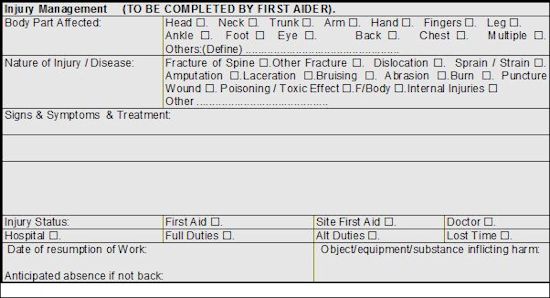
An Accident Report form is available for this purpose (show in Appendix 6) and must be completed by the immediate superior of the person(s) involved in the accident. This is necessary to monitor the progress of safety standards and to ensure that proper medical attention is given where required and as an aid in the identification of hazards so that the appropriate measures can be taken to prevent the accident from re-occurring.
Where an accident investigation is necessary, all staff are obliged to co-operate fully with such an investigation and to provide any information, which may be useful in establishing the circumstances leading up to the accident. All accidents investigated will have the investigation carried out by the Health and Safety Officer and a written report shall be prepared.
19 Board of Management Annual Review
The purpose of the Board of Management Annual Review is to present an overview of the progress made by the school over a 12-month period in the areas of safety, health and welfare.
A report will be generated at the end of the school year and may include the following information:
- Number of accident and / or incidents.
- Number of first aid incidents.
- Number of workdays lost as a result of incidents.
- Full details of any safety training carried out during the year.
Discussion of any areas of safety, health or welfare that need to be addressed in the future as a result of new legislation, incident history or any new work practices.
Scoil Naomh Fiachra welcomes any comments/queries or suggested initiative from any of its staff.
20 Members of Public, Contractors and Visitors
20.1 Visitors
It is recognised that members of the public are more susceptible to our occupational hazards due to unfamiliarity. Therefore, all staff must be aware to the dangers of having the members of the public on the premises and take all reasonably practicable measures to ensure that no member of the public is injured in any way while visiting the school premises.
The following procedures have been put in place to eliminate or minimise risk to the public and these procedures must be strictly enforced:
- Office area must be kept clear and free from slip-trip-fall hazards – any liquid spillages must be cleared up immediately and trailing cables and excess stock must be avoided where possible.
- No members of the public are permitted in storage areas.
- No members of the public are permitted to use hand or power tools on the premises.
20.2 Sub-Contractors
Sub-Contractors will not be allowed onto the premises to carry out work until the Board of Management has checked and is satisfied with their Health and Safety record and insurances.
The sub-contractors must liaise with the Headmaster of Scoil Naomh Fiachra and discuss and agree the safety precautions deemed necessary by either party. All sub-contractors are required to supply specific information and documentation as requested in the Scoil Naomh Fiachra Safety Statement. Failure to supply this information will constitute breach of contract and as such, the contract may be terminated.
21 Risk Assessments
21.1 Risk Assessment Process
Risk Assessments have been conducted in Scoil Naomh Fiachra and are attached to this Safety Statement. The risk assessment process involved the following:
- Identifying the hazards present within the school premises.
- Identifying what risks are associated with each of the hazards identified.
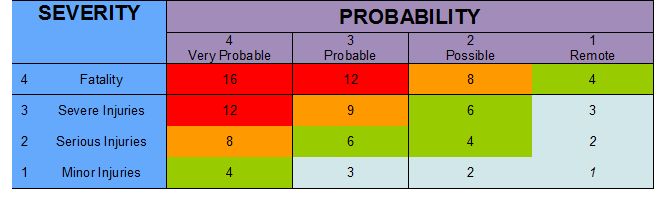
- Recording the probability and severity of injury/illness associated with the hazard. Calculating the risk rating based on probability and severity (the risk rating is arrived at by multiplying the probability of injury x severity of injury - see below for details).
- Actions are suggested to reduce the risk (control options) in order to ensure that risks are reduced to the lowest level reasonably practicable (see hierarchy of controls below).
- The hazards identified with a ‘High’ risk rating should be those that receive immediate attention. The implementation of the actions to reduce the risk should have a high priority.
Risk assessments should be reviewed annually and any necessary amendments made. They should also be reviewed if there is a change in circumstances e.g. new equipment, processes, procedures etc., following an accident or incident and in the event of new legislation, codes of practice or new guidance being published.
21.2 Hierarchy of Controls
The crucial part of the risk assessment process is selecting the most appropriate method of risk or hazard control. The following ‘hierarchy of controls’ should be used when deciding on control measures, starting with the first in the list and working down to the last control measure which is the provision of personal protective equipment and clothing.
- Elimination: Eliminating the hazard entirely from the workplace is the best way to control it.
- Example: provide a trolley to move around paper boxes which eliminates the need to carry out manual handling.
- Substitution: If not possible to eliminate the hazard, replace it with something less hazardous, which will perform the same task in a satisfactory manner.
- Example: substituting a smaller package or container to reduce the risk of manual handling injuries.
- Isolation:
Separate or Isolate the hazard from people. This method has its problems in that the hazard has not been removed. The guard or separation device is always at risk of being removed or circumvented.
Example: A guard is placed over apiece of moving machinery. If the guard is removed for maintenance and not replaced people are again at risk. - Engineering Solutions: If the hazard cannot be eliminated or a safer substitute implemented, then reduce the chance of hazardous contact.
- Examples of engineering controls are:
- enclosure (enclose in a way that eliminates or controls the risk).
- guarding/segregation of people.
- interlocks and cut-off switches.
- exhaust fans.
- Examples of engineering controls are:
- Administrative Solutions:
These are the management strategies which can be introduced such as training, job rotation, limitation of exposure time, provision of written work procedures.- Example:
- Safe systems of work that reduce the risk to an acceptable level.
- Written procedures that are known and understood by those affected.
- Adequate supervision.
- Identification of training needs and provision of appropriate training.
- Information/instruction (signs, handouts).
- Example:
- Personal Protective Equipment & Clothing:
Personal Protective Equipment and Clothing should always be considered as a last resort. It can also be used as an interim measure to reduce exposure to a hazard.- Examples of PPE include: masks, ear-plugs, respirators, helmets, boots, safety shoes, overalls, etc.
21.3 Summary
The most effective way to control risk is obviously to remove it. Elimination is by definition 100% effective. The further you go down the hierarchy of control list the less effective the methods become.
Risk Assessment Method Used
(Probability) x (Severity) = Risk Rating (RR)
 |
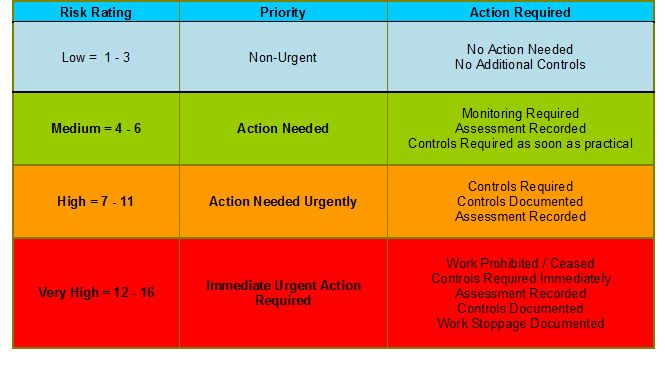 |
Risk Assessments conducted at Scoil Naomh Fiachra are attached in Appendix 7 of this Safety Statement.
22 Conclusion
The aim of Scoil Naomh Fiachra is to provide a safe and healthy environment for its staff, pupils, contractors and visitors. All requirements under the Safety, Health and Welfare at Work Act, 2005 will be adhered to and where reasonably practicable implemented. This can be achieved with the help and assistance of all by:
- All staff observing the general rules of safety and health. It is the duty of every staff member to fully comply with all safety rules and regulations. All Scoil Naomh Fiachra staff should inspect their workplace and report any unsafe condition.
- Using all equipment in a safe and proper manner. Notify any persons likely to be affected by work that you are doing.
- All injuries sustained by Scoil Naomh Fiachra pupils or staff, however slight must be reported to the Headmaster.
- Wear the appropriate PPE for all tasks undertaken. Employing the proper procedures when carrying out tasks and ensuring that no practices are used which may act as a source of danger to themselves or others.
- Keeping work areas clean and tidy at all times.
- Making sure all corridors and passageways particularly those leading to escape routes, are kept free of obstructions at all times. Do not litter, use the bins provided.
- Taking care that fire points are not blocked or covered up in any way and that access in the event of an emergency is un-hindered and that fire extinguishers are ready for use if the need arises.
- Follow all safety signs, and familiarise yourself with the Emergency Procedures.
- Vandalism of property will result in instant dismissal.
- Report any defects to the Headmaster immediately.
This Safety Statement has been prepared based on conditions existing in the fabric of Scoil Naomh Fiachra at the time of writing. It may be altered, revised or updated periodically in order to comply with any changes in conditions.
23 List of Appendices
Appendix 1: Inspection and Testing of Fire Prevention Equipment, Annual Fire Precautions.
Appendix 2: First Aid Box Contents & Names of First Aiders.
Appendix 3: VDU User Checklist, VDU Workstation Set-up Diagrams.
Appendix 4: Inspection and Testing Schedule for Electrical Equipment.
Appendix 6: Accident / Incident Form.
Appendix 7: Risk Assessments.
Appendix 8: Staff Declaration – Signatures.
Appendix 1 – Inspection and Testing of Fire Prevention Equipment
Summary of inspections and testing for Fire Prevention Equipment
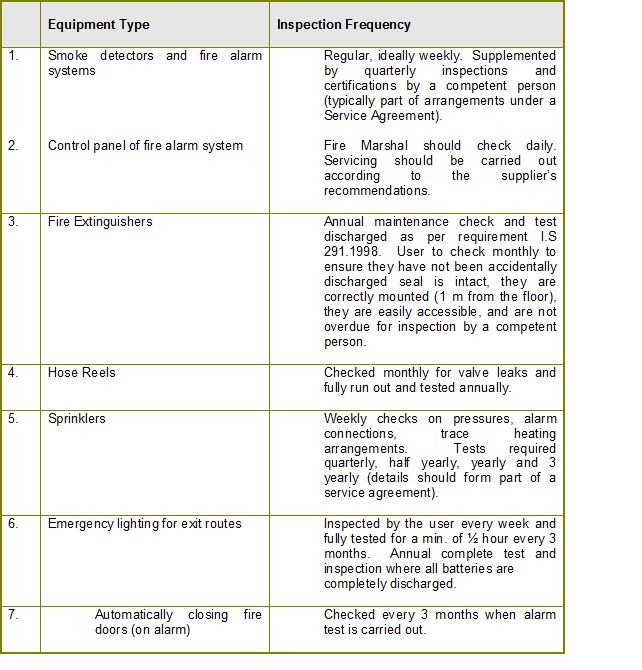 |
Note: Records to be kept of all inspections, tests, defects and action taken
RECOMMENDED CONTENTS OF FIRST AID BOXES
 |
 |
Appendix 2 – VDU User Checklist & VDU WORKSTATION SETUP DIAGRAMS
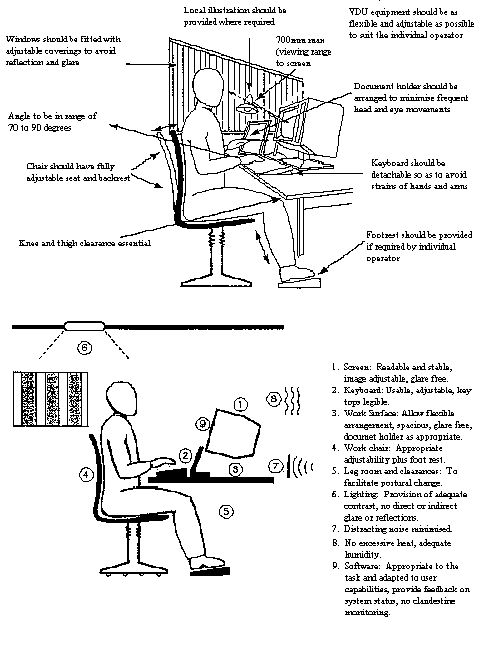
- The following guidelines are intended to help staff understand and reduce health risks associated with computer workstations. Since no two bodies are identical, different styles, models, and sizes of furniture and accessories may be needed. Since a wide variety of products are available to suit individual and departmental needs, no specific product recommendations are made here. The best results are usually achieved when the individual is involved in the selection process.
- The work surface should be of sufficient area to accommodate the computer and all associated materials. There should be adequate space beneath this surface for the operator’s legs and feet.
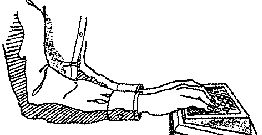
- The keyboard and mouse should be directly in front of the operator at a height that favours a neutral posture (23 to 28 inches). When placed at standard desk height of 30 inches, they are too high for most people. Raising the chair solves this problem for some individuals. An adjustable keyboard holder with mouse deck is usually the best solution. The objective is a posture with upper arms relaxed and wrists straight in line with the forearm. Wrist rests may also help and are built into most keyboard holders. For some people alternative keyboard and mouse designs may need to be considered.
 |
- The monitor should be positioned at a distance of approximately arm’s length and directly in front of or slightly to one side of the operator. The top of the screen should be no higher than eye level. A monitor placed on top of the computer can easily be lowered by relocating the computer. Stackable monitor blocks can be used to achieve the desired height. Adjustable monitor arms enable easy height adjustment for workstations with multiple users.
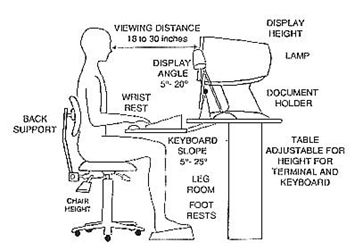 |
- A well designed chair will favourably affect posture, circulation, the amount of effort required to maintain good posture, and the amount of strain on the back. An adjustable seat back is best for support in the lumbar region. The user should be able to adjust seat height and seat pan angle from a seated position. Armrests are optional.
- Additional accessories can improve operator comfort. Document holders can minimize eye, neck and shoulder strain by positioning the document close to the monitor. A footrest should be used where the feet cannot be placed firmly on the floor. Task lamps will illuminate source documents when room lighting is reduced.
- Glare should be eliminated through methods that include reduction of room lighting; shielding windows with shades, curtains or blinds; positioning the terminal at a right angle to windows; and tilting the monitor to avoid reflection from overhead lighting. Glare screens are not normally necessary. All computer users should receive basic training in potential health effects that may result from poor posture and work habits, early warning symptoms, workstation adjustment, and other self-help protective measures. Supervisors should receive similar training to easily recognize problems and know what corrective measures to take.
VDU USER CHECKLIST
- Adjust seat height so that lower arms are horizontal and wrists straight when operating keyboard.
- Use footrest if feet can’t touch floor.
- Adjust height and tilt of backrest so that upper back is supported. This will help maintain natural curve in lower back.
- Avoid slouching/leaning over by removing obstacles from under desk.
- Adjust height of display screen so that angle of viewing is 15-20°.
- Place document holder at equal distance and height to screen.
- Adjust screen angle and window coverings to avoid unwanted reflections.
- Adjust brightness/contrast controls.
- Vary distance of display viewing distance during day.
- Break up the day with regular changes of activity – away from the screen and keyboard.
- Clean your screen.
- Have regular eyesight tests for VDU work.
 |
APPENDIX 3 – Inspection and Testing Schedule for Electrical Equipment
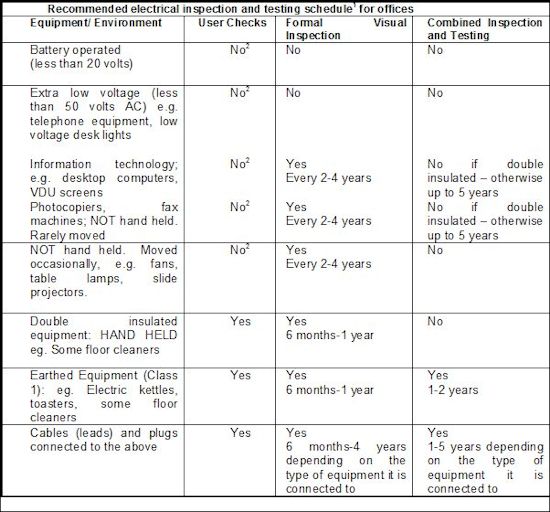 |
1 Experience of operating the inspection and testing schedule outlined in the table over a period of time, together with information on faults found, should be used to review the frequency of inspection. It should also be used to review whether and how often equipment and associated leads and plugs should receive a combined inspection and test. This may be reviewed and decided upon either by a manager, with guidance from the relevant competent person, or by the team carrying out the electrical inspections.
2. “No” means no formal, recorded checks, but users should always visually inspect equipment to be used, and respond to any evidence of fault or damage.
APPENDIX 4 – Accident / Incident Report Form
 |
 |
 |
APPENDIX 5 – Risk Assessments
Risk Assessments
RA No.1.01 Security
RA No.1.02 Fire
RA No.1.03 Classroom 1
RA No.1.04 Welfare Facilities
RA No.1.05 Classroom 2
RA No.1.06 Hallway
RA No.1.07 Classroom 3
RA No.1.08 Classroom 4
RA No.1.09 Server & Storage Room
RA No.1.10 Office Safety
RA No.1.11 Electricity
RA No.1.12 Changing Photocopier Cartridge
RA No.1.13 Changing Printer Cartridge
RA No.1.14 Cleaning of School
RA No.1.15 Playground
RA No.1.16 Car Parking
RA No.1.17 Manual Handling
RA No.1.18 Stress
RA No.1.19 Bullying & Harassment
RA No.1.20 VDU’s
RA No.1.21 Use of Sharp Objects
RA No.1.22 Pregnant Employees
RA No.1.23 Housekeeping
RA No.1.24 Operation of Shredder
RA No.1.25 Use of Machinery
APPENDIX 6 – Staff Declaration
I have read the safety statement and understand my obligations and duties therein. I understand that these obligations and duties are legal requirements under The Safety, Health & Welfare at Work Act, 2005.
 |